
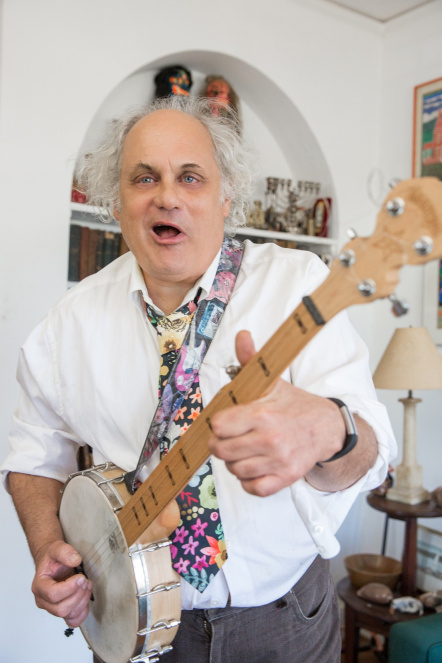
We can thank John Zorn for connecting Eyal Maoz and Eugene Chadbourne, both of whom he’s worked with in the past. The two have produced a fascinating album for the Infrequent Seams label called The Coincidence Masters.
Chadbourne and I have been trading emails, and he’s been sending along recordings which I’ll feature on episode 324. The chat got off to a head-slapping start.
Hi Eugene. Just downloaded “Ask Me Now?” Love it! Can I tell everyone that you wrote a song about me?
Thelonious Monk wrote that.
Oh dear. Now I’m embarrassed. On a more professional note, please tell me about the new album. This is your first recorded collaboration with Eyal I believe.
On not recognizing the Monk tune, it reminded me of one of my own embarrassing moments as a fledgling journalist. I was out in Vancouver listening to Pharoah Sanders every night and hoping to sell a profile to Creem, which I couldn’t in the end but the proposal convinced the owner of “Lucy’s Jazz Workshop” to let me in free every night.
On one set Pharaoh played a ballad I didnt recognize so I went backstage with my pad and pen to ask him what it was. He was already totally annoyed with me following him around trying to do an interview.
He said “You’re a music critic. It’s by Sam Cooke. You should know it.”
As a performer I have experienced multiple “assumptions” by critics about material I have played, they might credit me with writing a song by Love for example (which they ought to recognize if they are music critics) or in an extreme example not understand I used a snippet of an absurd recording of the Muddy Waters song “I’m Ready” done by the MORMON TABERNACLE CHOIR in an intro to my own version on the “Texas Sessions Chapter two.” He thought the full choir was my own doing.
While it is probably not the greatest idea to transition from the Mormons to Eyal, to answer your question, I had no knowledge whatsoever of the guy but he had gotten my number from John Zorn who gave me his recommendation which goes a long way, I was doing a variety of things in Manhattan and Brooklyn at the time and on a free day I went over to a place in the Wall Street area and we jammed for a few hours. I wouldn’t know how else to describe it. It is not always easy to make guitar duets interesting, and I mean for the listener, unless I really can’t stand someone’s playing I would always find the interaction and the basic activity of jamming really enjoyable, but listening to the two guitars? Sometimes I am sure it can be great, I hope people like this! I have not been listening to the tracks and don’t remember them at all other than his responses and proposals coming very quickly and thoughtfully.
“Thelonious Monk wrote that.”
Eugene Chadbourne
Is there an assumption that people have made about you most often over the years? You’ve always struck me as an artist we shouldn’t assume anything about.
I had to think a bit about what the nature of an assumption would be in the context of music criticism or other sorts of coverage. What we were talking about before were small lapses in knowledge that could mean a writer is out of their depth but also can be easily excused since it is not really possible to know absolutely everything, every title, every whatnot.
I’ve settled on the results of writers assuming an idea they’ve come up with has some real meaning. Often these are slogans or labels.
With me one commonly used was “deconstruction.” There was really an uptick in coverage on me when the Shockabilly band did a couple of national and European tours, so I don’t know where this idea originated exactly. It was something many reviewers settled on. It could show up in both positive and negative write ups. I still don’t get the connection exactly other than it is the result of someone only half listening.
I developed my music out of a background of playing blues in coffeehouses and rock and roll at teenage parties. But we also played avant garde music in the teen years. We were influenced by Frank Zappa mostly but I quickly ditched that for jazz. In Boulder where I grew up there were some really strong avant garde influences – the composer George Crumb was at the university, the musique concrete composer Tod Dockstader had his own label and they played his amazing pieces on the free-form FM radio station and there was the local hot shot guitarist Tommy Bolin playing lengthy effectron guitar solos in the band Zephyr.
Shockabilly developed out of the Chadbournes, these bands worked with song repertoires into which wild improvising was splashed and dabbed! I was really enamored of jazz song intepretations, especially Coltrane’s “My Favorite Things.” I wanted every song to be like that. But to me that was constructing something out of something else, it wasn’t taking something and destroying it.
So I felt like this assumption was about not really hearing what we were doing but not exactly disliking it – so coming up with some kind of way of praising it, a label that is supposed to describe it but in this way was really dramatically wrong. They should have called it “construction.”
David Harrington told me a story about ordering the sheet music for Crumb’s “Black Angels.” What was your initial reaction to Crumb specifically, and the avant-garde more generally? In retrospect, why do you think you were so open to it?
I wonder whether I would enjoy ordering the sheet music for “Black Angels.” And I would love to hear the story.
I think that was the piece I heard performed in high school. Boulder High School was experimenting with different aspects of open education and I had several classes where I was working independently and didn’t have to show up, so often I would be up at the University campus. I must have heard about the Crumb event from a music teacher I had at one point, Eloise Ristad. Her husband was my social studies teacher. They were friends with the pianist David Burge, who I think recorded some of the Crumb pieces as well as other stuff.
I only remember that the cello was electric and the pianist was crawling around under the piano playing the wood with mallets. I thought the whole experience was amazing. But thinking about my circle of friends, some of whom were in the bands I was in, I was the one that was into the most far out music. I don’t remember anyone whose taste was weirder than mine. It was always me looking for the most unusual things to happen in music, I guess that would be a good way of describing it. I loved the most far out parts of the Hendrix records while some of the gang I used to play football with thought it was too weird and he should stick to straight rock and roll. This one guy who was sort of a desirable upright bass player and musical know-it-all was really reluctant to freak out. He was listening to Elton John, Led Zeppelin, Grand Funk Railroad.
So obviously this avant-garde community was flourishing on campus but they obviously weren’t going to take me in. I was just a high school kid and I couldn’t even read music properly. I did get in with a little older crowd, but it was the scene around the campus coffee shop in the student union and the ad hoc outdoor shows in various parts of Boulder Canyon. I would play acoustic blues in those settings – Son House, Bukka White, Lightnin Hopkins -nobody really knew what it was, it was really erudite. I was writing my own songs, using open tunings and influenced by Steve Stills. But that material was mostly heard by my school friends.
Has going your own way like this ever felt uncomfortable? Or did it serve as more of an inspiration?
With a few bumps here and there I would have to say I always regarded it as an advantage, like having any strong interests that could for instance occupy you in adolescent years if you didn’t have friends beating down your doors.
There’s also prestige associated with being considered too-whatever for certain jobs or associations. Like not getting accepted in the program for the Boulder High School Folk Club because I auditioned with a version of John Lee Hooker’s “I Don’t Want to Go to Vietnam.”
To what extent do you think creativity – particularly when it takes an extreme form – is a reaction to societal norms? You’ve always gone your own way. What is it about you and your personality that produces all of this incredible music?
Thanks for the compliment, had to think about some of this awhile. I’ve always felt creativity could be described in the terms you use, forms such as free improvisation, free jazz and modern composition are to me political statements in themselves, whether or not there are overt political references or lyrics or what not doesn’t matter. While being creative could be considered a societal norm in the way it is presented for example to children in school art or writing classes, you are right to refer to extreme forms to differentiate between for example a basket weaving club and a joker writing an opera.
It is interesting about personality and music. You see I would perceive my personality and my music as being one and the same. I am creating music primarily that I want to listen to, that no one else is doing in exactly this way. Of course my personality exists outside my music – in life, in my interactions and relationship with my wife, children, grandchildren, friends. Now they would joke about meeting someone who knows my music and assumes that I must be totally insane, and they’d have to explain: “Hey, Eugene doesn’t sit around all day playing electric rake solos.”
I have created a huge catalog of my music in both studio and settings, they also overlap with a lot of live work documented with portable studio desks or even trucks. There are all the genres that I like to play and many interpretations of other songwriters and composers as well as my own work. As an avid music listener I know there are other artists whose documentation is equally vast or even larger, and at the other end of the spectrum there are artists who barely manage to record more than a few sides.
What factors go into this? I began toying with recording equipment as a child, developed a hands on approach and can’t really remember a time when I wasn’t recording something or other. Of course it got really serious when I got so much positive feedback from Anthony Braxton. At that point I thought I must really be onto something. I developed a knack for doing things quickly in studio settings, one or two takes. I’ve had a lot of different recording experiences and these projects tend to sound very different from each other. Parallel to having an opportunity to produce professional sounding projects in studios, I got into what is called the cassette underground. This was an opportunity to release really raw things, sometimes making only a few copies.
There are collectors now that defy this proposition. They don’t want anything to go out of print, so this “few copies’ eventually turns into a catalog item available indefinitely.
It all adds up to a lot of stuff, I don’t fuss over it.
The best description came from my friend the late film director Wes Craven: “There is no buffing wheel in Doc Chad’s workshop.”
 The Moderns
Leave a Reply