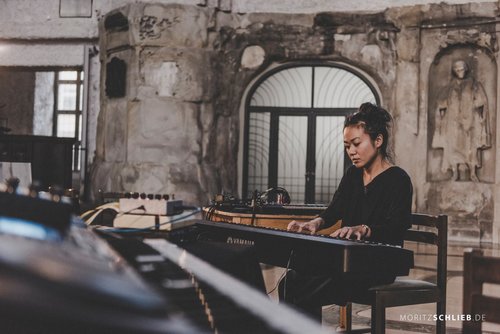
As often as we celebrate the do-it-yourself approach to contemporary music, it’s clear that those who’ve committed themselves to formal training bring something powerful to whichever genre they choose to focus on.
Midori Hirano grew up in Kyoto, Japan studying piano. She didn’t study composition to any great extent, but as her craft evolved Hirano found herself increasingly focused on writing new music. Around the same time, she came into contact with a variety of contemporary styles that began to colour her work.
Since her recording debut in 2006, Hirano has released music under both her own name and under MimiCof. The former is piano-based primarily, with additional elements. The latter is, in her words, “experimental music with less harmony.”
Hirano and I traded emails last month.
How do you describe your work?
Piano has always been a fundamental part of my music, having learned it from an early age and studying the instrument at university. But I have become more interested in electronic music in the last 20 years. I incorporate sounds of different kinds into a piece of music, including synthesizers and other electronic instruments, field recordings and even beats.
Sometimes I improvise on the piano to record and then take it apart to reconstruct, or I take bits of natural or industrial sounds recorded outside and process them so that they don’t sound like the original sounds.
The foundation of my music is still based on the more classical method of creating harmonies and melodies on the keyboard. But I keep getting inspired by moving back and forth between these different types of sounds.
It took me a few years to feel confident that I was making my own music with electronics, but the joy I felt when I was able to make music that I never expected was what motivated me to keep at it.
Midori Hirano
Did you feel constrained by your classical training?
When I was about to finish my studies in the early 2000s, I began to feel constricted and couldn’t really see myself continuing with classical music. Although composition wasn’t part of my main studies, I found more artistic freedom in composition, so I started composing with the piano at first. And at the same time, I was introduced to a computer and became interested in using software and synthesizers to produce music.
It took me a few years to feel confident that I was making my own music with electronics, but the joy I felt when I was able to make music that I never expected was what motivated me to keep at it. And I still feel that way.
After finishing my studies, I moved from my hometown of Kyoto to Tokyo to work at a music studio. Working there helped me learn how to use electronics as well. While I was living in Tokyo, I was introduced to not only club music but also experimental music concerts, which I found quite fascinating.
At that time, there was a very small venue called offsite which was located in a residential area in Tokyo, where only quiet music was allowed because of the neighbours. A lot of experimental, improvised music concerts were held there. It was very special because the audience was really focused on listening to the music played at a low volume. It was the opposite of what you usually experience in a music hall.
It doesn’t mean that I wanted to make and play the same kind of music, but my listening experience there certainly inspired and showed me that there is more freedom in making music than I thought.
I think the people who immerse themselves in classical music have a greater capacity to appreciate non-traditional forms, simply by virtue of their comfort with complex music. And yet so few people make the transition. Most spend their lives loving traditional classical music. Obviously, taste is a personal thing, but why do you think so many classical music lovers reject anything remotely outside the traditions?
I think it really depends on the depth of each person’s relationship with classical music and how they grew up with it. Speaking from my own experience as a musician, I started to seek and accept different types of music outside the traditions, simply because I couldn’t see myself belonging to the classical music world anymore and wanted to see other sides of music where I could find a place for myself.
We are all blessed with the opportunity to discover so much diverse music online. Maybe people will develop a freer way of interacting with music than we do now. And maybe the definition of classical music will shift.
Do you think you’ll continue to move toward less traditional styles, or have you reached a kind of happy medium where you’ll continue to combine influences?
I still appreciate the fact that I have learned classical music and the basic chord progressions through that, because I’m sure that is still very much ingrained in the way I compose. It’s a big part of my musical style. So, I would say that I’m at a point now where I’m able to incorporate both of these different musical influences into my music, and I’m probably going to keep that style by being open to any kind of music that inspires me.
How do Midori Hirano works differ from those under the name MimiCof?
As MimiCof, I want to specialize in pure electronic sound without the use of piano or other live instruments. It’s more of an experimental music with less harmony, compared to the music I make under my own name which focuses on piano with some synthetic sounds.
I sometimes feel that there is an overlap between my two projects. Maybe I will combine everything into one project in the future, but for now I will keep these projects separate.
 The Moderns
Leave a Reply