
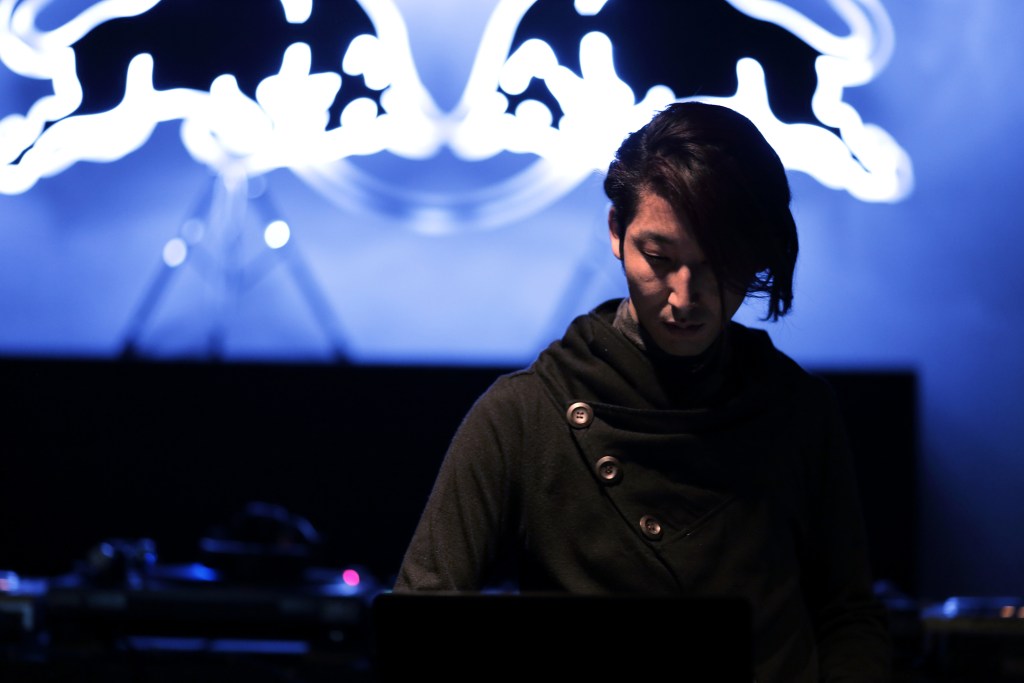
Tokyo’s Yui Onodera is among the world’s great composers and sound artists. He describes his work as a kind of nexus “between musical forms, architectural acoustics and spatial awareness.” His catalogue includes collaborations with Francisco Lopez, Stephen Vitiello, Robert Lippok, Scanner, Pjusk and Yotam Avni. He is also a sound art lecturer at Rikkyo University and Musashino Art University.
His most recent release is a repackaging of 2015’s Semi Lattice, out now on Dragon’s Eye Recordings.
Onodera and I traded emails about music, architecture and more.
Let’s begin with the Ryuichi Sakamoto tribute you’re part of. What did he mean to you, both professionally and personally?
While I knew Yellow Magic Orchestra, I hadn’t delved deeply into Sakamoto’s music. It was his collaboration with Carsten Nicolai, Vrioon, that strongly drew me to his work. Of course, I knew about Merry Christmas Mr. Lawrence and a few other tracks through television and radio, but my conscious appreciation began with his works from the 2000s onwards, when he actively engaged in ambient music and sound art. I believe we first met at the exhibition at the NTT InterCommunication Center [ICC] in 2017. Sakamoto was showcasing an installation with Shiro Takatani from Dumb Type, while I exhibited an audio-visual installation as part of my art collective, nor.
Your bio describes a relationship between music and “architectural acoustics and spatial awareness.” Can you explain how that has manifested in your work?
Much of this is practiced in installation exhibitions, as well as social implementation projects in urban spaces such as commercial facilities, offices and restaurants. I often liken it to cooking. A chef not only prepares the meal but also presents it in the most enhancing vessel when delivering it to the guests. Neither the meal nor the vessel alone is sufficient for the experience; it is the harmonious interaction between both that creates the environment in which the chef’s desired dish can be enjoyed.
I have long been interested in the psychological and physiological reactions that sound or music brings through experiential engagement with space. While sound, like light and temperature in spatial/environmental design, is intangible, it is a crucial component in the experience.
Architecture exists in dialogue with the natural environment. It is more complex and socially engaged. Utilizing comprehensive knowledge and technology in physics, structure and facilities, architecture treats the city like a canvas, where one can express themselves.
Yui Onodera
You studied music and architectural design. Were those separate studies, or did you study a combination of the two right from the start?
Originally, I studied guitar at a music school. Soon, I developed an interest in composing using computers. It wasn’t until several years later that I began to delve into architectural design earnestly. In my early twenties, I spent a few months in Berlin. I lived in the Kreuzberg area, a bit away from Mitte. One day, while walking through the streets, I encountered a remarkable piece of architecture. It was the Jewish Museum Berlin, designed by Daniel Libeskind. Although I would later come to learn more about this building, in that moment of encountering it, I felt an immediate urge to return home and study architecture. There was something about the energy of that architecture that resonated deeply with me.
What led you to that focus?
After releasing several albums from labels in the United States, Germany, etc., I began to feel frustrated with the limitation of recorded works as albums. Just like literary works that can be experienced anytime, albums can be listened to anytime, anywhere by anyone. This way, albums become experiences detached from the dynamic uncertainty of time and space.
It was during such times that architecture felt like a comprehensive art form to me. It’s not just about form and texture; architecture interacts with the surrounding environment, considering factors such as sunlight and local weather conditions. Architecture exists in dialogue with the natural environment. It is more complex and socially engaged. Utilizing comprehensive knowledge and technology in physics, structure and facilities, architecture treats the city like a canvas, where one can express themselves. I found the allure of being able to express oneself on a larger scale compelling. Iannis Xenakis, too, drew significant inspiration from both architecture and music, and I deeply resonate with that sentiment.
Can you explain the difference between “environmental music” and “ambient music?” There’s a distinction there that I think sometimes gets lost in the translation.
It depends on whether it’s site-specific. Rather than being guaranteed as reproducible recorded works, these are auditory experiences specific to particular environments, optimized by tailored sound systems. While it has become quite common as installations nowadays, Brian Eno’s Music for Airports was originally composed for a specific location. Nowadays, with cutting-edge technology, it is possible to dynamically generate sound just like Japan’s old environmental design, including wind chimes, scarecrows and water harps. I define such sound-based environmental designs as environmental music. In recent years, one of the projects I produced received the Highly Commended award in the Best Sound Innovation in Everyday Life category at the UK’s Sound of the Year Awards 2021, with Matthew Herbert serving as the chairman of the judging panel.
To my ear, your work feels distinctly urban at times, rural at others. Does that resonate with you? Are your recordings ever site-specific?
Perhaps my personal mood, the recording, or the place where it was produced has influenced it. While I’ve lived in Tokyo for a long time, I hail from Iwate, a cold northern provincial city. I’ve never considered my music to be particularly urban. Come to think of it, I do enjoy Icelandic music, so perhaps my preferences are influenced by the environment based on my background.
You have re-released your 2015 recording Semi Lattice, inspired by the work of architect Christopher Alexander. Why is his idea of natural vs. planned city design important right now? Do you think we’re doing a good job, internationally, of urban design?
I resonated with his perspective because I wanted to adapt it to the structures that compose music. When using what could be termed as conventional music theory, typically taught in music schools, complex issues often need to be simplified for comprehension. Therefore, structuring based on versatile, simple rules, layered multiplicatively, tends to simulate complexity. However, I desired to incorporate into music the complexity and diversity akin to more intricate natural physics, textiles or plaster walls, which cannot be easily factored. I aimed for an auditory organism that feels less artificially planned but rather embodies the complexity generated by nature.
 The Moderns
Leave a Reply