
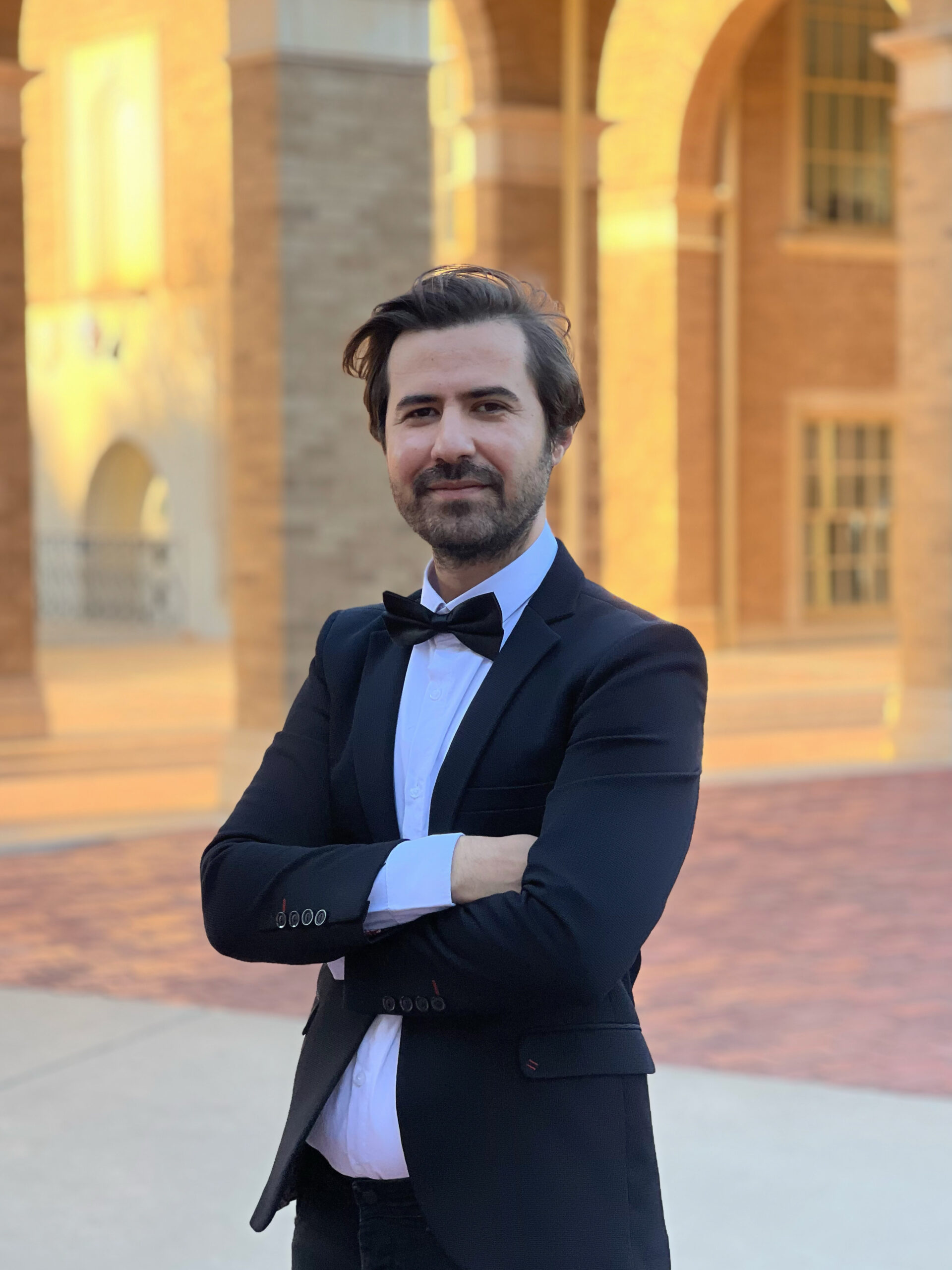
Ali Balighi is a Tehran-born composer, sound designer and sound engineer. He is at Texas Tech University currently, studying for a Doctor of Musical Arts in Composition. His new LP lands May 3 on Noise à Noise. It’s entitled Qaf Mount Ballet.
Tell us about the new album.
It comprises 18 distinct movements. Drawing inspiration from Persian mythology, particularly the significance of Mount Qaf, a recurring motif in ancient tales and legends. The album delves into its symbolic representation as the threshold between mortal existence and divine realms. Through the collaborative efforts of Hana Mesgari’s narration and Ehsan Saboohi’s writing, the narrative surrounding Mount Qaf takes on a contemporary resonance, intertwining with the political landscape of modern-day Iran while honouring its deep-rooted Persian heritage.
The creation of all sounds for this piece is accomplished through SuperCollider 3.13.0, an open-source music language, with mixing executed using Logic Pro. Compositional techniques employed emphasize the exploration of polyrhythms, polytempos, polymeters and microtonal pitches, enriching the musical experience with intricate layers of rhythm and harmony.
Can you tell us a little bit about the myth, and its significance for you?
Numerous composers, like George Crumb in “Black Angels,” have worked in the realm of myth, sparking my ongoing contemplation of its role in music. Qaf Mount Ballet draws its inspiration from the renowned Persian myth of Simurgh – a benevolent bird deeply rooted in Persian mythology and literature, distinct from other mythical avian figures like the phoenix or humā. Reverberating through various eras of Iranian art and literature, the Simurgh’s significance is profound. Its name, “sī murğ,” translates to “thirty birds” in Persian, a motif cleverly employed by Attar of Nishapur in his allegorical masterpiece “The Conference of the Birds.”
Ehsan Saboohi, an Iranian contemporary composer and the visionary behind the Post-Orientalism foundation, penned the text of Qaf Mount Ballet, weaving the Simurgh myth into a narrative that resonates with contemporary Iranian politics. Through the voice of a bird narrator, Saboohi paints a picture of impending change akin to a revolution, yet unlike the myth, the outcome remains obscured. The narrator’s uncertainty lingers, torn between waiting and seeking a new path forward.
Given my deep-rooted interest in contemporary movements advocating for freedom and rights, especially Woman-Life-Freedom, I wanted to compose a new piece inspired by this myth.
How would you describe the state of contemporary art in Iran presently?
During the reign of the last Persian Shah, Mohammad Reza Shah, there was a notable increase in opportunities for artists and students to travel to Europe and explore various artistic disciplines such as painting, theater, music, dance and cinema. Upon returning to Iran after their education, they began to impart their knowledge in diverse fields, blending elements of Persian arts with modern artistry.
In the realm of music, Alireza Mashayekhi, for instance, innovatively merged electronic music with Persian microtonal music, showcasing the distinct properties of microtonal compositions in contrast to conventional European music. Similarly, poets like Nima Yoshij restructured poetry influenced by European styles, particularly those from France and Germany.
Today, artists continue to have ample opportunities to engage in creative endeavours beyond Iran’s borders, frequently travelling to Europe and the U.S. to showcase their music, films and other media. Their artistry reflects a fusion of modern techniques with traditional Persian aesthetics, setting their work apart from that of their peers.
That combination – of traditional Persian sounds and modern music – is one we’ve heard executed successfully over and over again. Fascinating to think that music with such a long history still resonates in such a modern context.
Creating music that blends contemporary styles with Persian traditions such as Dastgah or folk music requires composers to possess a dual understanding and a fresh perspective. Microtonality plays a crucial role in Persian and Middle Eastern music, including Persian, Kurdish, Azerbaijani and Arabic traditions. These musical systems rely heavily on tetrachords, where modes may comprise multiple tetrachords with varying accidentals across registers.
Microtonal intervals form the foundation of these modes, distinct from the passing tones found in Western music. While composers like Giacinto Scelsi and Dimitri Papageorgiou explore microtonality, performers face challenges navigating sudden leaps between microtonal notes. Persian composers must articulate their musical ideas clearly to ensure accurate performance.
Performing microtonal music poses additional complexities, as quarter tones may deviate from the standardized 50 cents and instead span 64 cents or more, depending on the tradition. Persian musicians possess a keen sensitivity to these nuances, unlike their Western counterparts.
Addressing these challenges, some composers incorporate Persian instruments like the santur and tar into their compositions, as seen in my compositions such as “Walking in The Darkness” and “Daramad for Tar and fixed media.” However, limitations in contemporary techniques for these instruments and the scarcity of skilled performers, particularly outside regions with strong Persian music traditions, such as Texas, can hinder realization.
Another approach involves integrating microtonality into fixed media segments, enabling Western musicians to perform using the familiar 12-tone system. Additionally, electronic music platforms like Csound, SuperCollider and Max/MSP offer composers greater flexibility in exploring intricate microtonal nuances.
Persian music’s unique tonal perspective offers contemporary composers a distinctive palette for innovation, distinguishing their compositions from others. This fusion of traditions fosters novel avenues for creative expression, enriching the contemporary music landscape.
Do you have an intended audience for your work, and does that impact compositional choices in any way?
Throughout my journey as a composer, my audience has evolved significantly, impacting my compositional choices along the way. In Iran, where I initially honed my craft, my focus leaned heavily towards experimental music, and I had numerous opportunities to showcase my work through performances.
Upon relocating to the U.S. for my studies, my avenues for performance became limited to university settings due to work restrictions. However, this constraint has not stifled my creative output. Instead, it has shifted my approach towards dissemination, allowing me to share my compositions with various ensembles and orchestras affiliated with universities across the country.
My music has found its way onto the stages of renowned festivals and conferences worldwide, including Sonic Matter, New York City Electroacoustic Music Festival and Tehran Contemporary Music Festival, among others. This diverse exposure has broadened my understanding of audience reception and further influenced my compositional path.
As a contemporary composer, I am driven by a pursuit of innovation. Whether exploring new instrumental techniques or pushing the boundaries of electronic composition, my primary focus remains on the music itself. Each composition serves as a way for experimentation, as I continually seek to unearth new dimensions of creativity and expression.
 The Moderns
Leave a Reply